
Quick answer
Plain water does not break a fast. It has no calories, protein, fat, or carbohydrate, so it never triggers the insulin response that ends a fasted state. Black coffee and plain tea are treated the same way by almost every intermittent fasting protocol. Anything with calories, such as sugar, cream, juice, or most flavored electrolyte drinks, technically ends the fast, even in small amounts.
What actually breaks a fast
Intermittent fasting works on a fairly simple mechanism: your body shifts between a fed state, where insulin rises to help store the calories you just ate, and a fasted state, where insulin drops and the body relies more on stored energy. What flips that switch is calories, not the clock or the type of container something comes in. Johns Hopkins Medicine has a plain-language overview of how the fed and fasted states work if you want the longer explanation.
In practice, these end a fasting window regardless of the plan you are following:
- Sugar, honey, or syrup in any drink
- Cream, milk, or creamer in coffee or tea
- Fruit juice, regular soda, or flavored sports drinks
- Most protein shakes and bone broth
- Chewing gum or mints that contain sugar
- Alcohol, which also affects blood sugar and judgment
None of these add up to many calories on their own. Fasting protocols use the presence of calories, not the amount, as the line that matters.
Drinks that don't break a fast
- Plain water, still or sparkling, with no sweeteners or flavoring.
- Black coffee, with nothing added beyond the coffee itself.
- Plain tea, including green, black, and herbal varieties, without milk or sugar.
- Sugar-free electrolytes, meaning sodium, potassium, or magnesium without added carbohydrate.
Diet soda and sweetener-only drinks sit in a genuine gray area. They carry close to zero calories, so many fasting guides treat them as acceptable. Some people avoid them anyway, since the sweet taste alone is debated as a possible trigger for appetite or a mild insulin response in some people, even without calories. If you are fasting for a blood sugar or appetite reason rather than purely as a scheduling tool, plain water or black coffee is the more cautious default.
How much water to drink during a fasting window
Fasting does not lower your body's baseline need for fluid, so ordinary daily guidance still applies. The Mayo Clinic summarizes the U.S. National Academies of Sciences, Engineering, and Medicine's general guidance as roughly 15.5 cups (about 3.7 liters) of fluids a day for men and 11.5 cups (about 2.7 liters) for women, including fluid from food. That total is a starting point, not a fixed target: body size, activity level, climate, and health conditions all shift it, so it is worth treating as a general reference rather than a personal prescription.
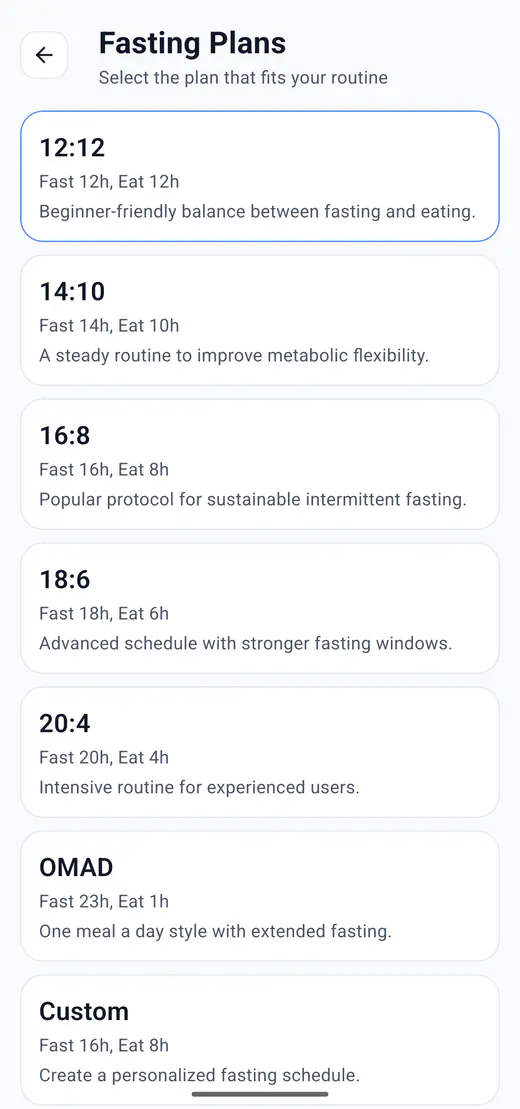
That amount does not need to be squeezed entirely into your eating window. Spreading it across the fasting window as well keeps you from front-loading or back-loading a large volume into a short stretch of time. On longer plans, such as 18:6, 20:4, or OMAD, most of the day happens without food, so water is doing more of the daily fluid work than it would on a shorter schedule like 12:12 or 14:10. See how the different fasting schedules compare if you have not settled on one yet.
Signs you are not drinking enough during a fast
- Persistent thirst that does not ease after a small sip
- Dark yellow urine
- Headache, particularly on longer fasting windows
- Fatigue or difficulty concentrating
- Dizziness, especially when standing up quickly
- Dry mouth or lips
These are general hydration signals, not fasting-specific ones, and several can also point to something unrelated to fluid intake, such as low sodium on a longer fast. If they show up often or feel severe, that is worth discussing with a healthcare professional rather than solving through tracking alone.
Quick reference: what's fasting-safe
On a narrow screen, scroll the table sideways. Keyboard users can focus it and use the arrow keys.
| Drink | Verdict | Why |
|---|---|---|
| Plain water (still or sparkling) | Fasting-safe | No calories or macronutrients. |
| Black coffee | Widely accepted | Negligible calories in typical amounts. |
| Plain tea (green, black, herbal) | Widely accepted | Negligible calories without milk or sugar. |
| Sugar-free electrolytes | Usually fine | No added carbohydrate. |
| Diet soda or artificial sweeteners | Gray area | Near-zero calories, but the sweet taste is debated. |
| Coffee or tea with milk, cream, or sugar | Breaks a fast | Contains calories. |
| Fruit juice or regular soda | Breaks a fast | Contains sugar and calories. |
| Bone broth or protein shakes | Breaks a fast | Contains protein and calories. |
| Alcohol | Breaks a fast | Contains calories and affects blood sugar. |
Tracking water and fasting without losing track of either
The confusion around water and fasting is often less about biology and more about tracking. When water logging lives in one app and a fasting timer lives in another, it is easy to lose the thread of which numbers belong to which window, especially across an 18- or 20-hour fast.
HydroFast keeps both in the same place. The fasting timer runs independently from water logging, so entering a glass of water during an active fast does not pause, interrupt, or reset the session.
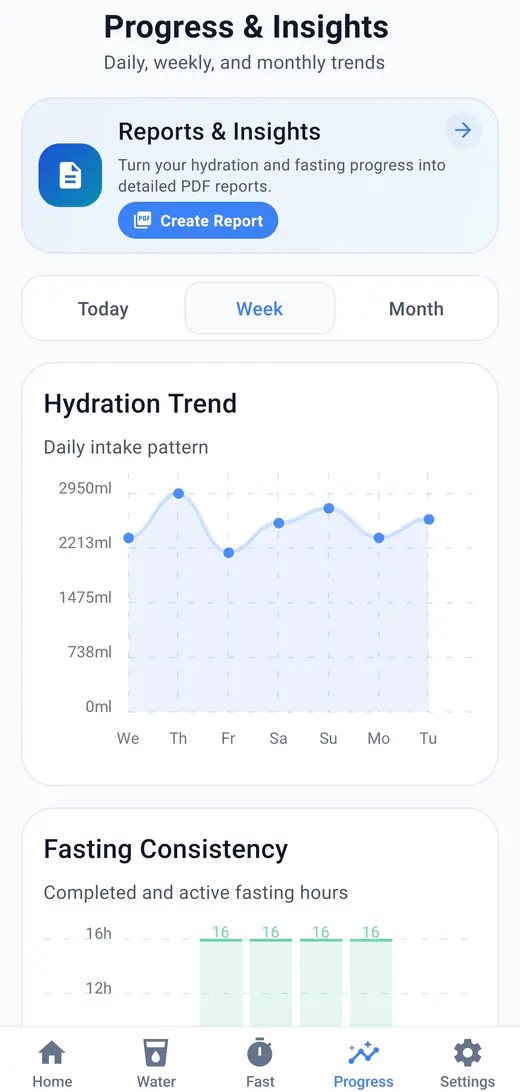
Seeing the week's hydration trend next to fasting consistency makes it easier to check whether a rough afternoon lines up with a low-hydration day, a longer-than-usual fast, or both. Explore the HydroFast fasting tracker or the HydroFast hydration tracker to see the logging screens directly.
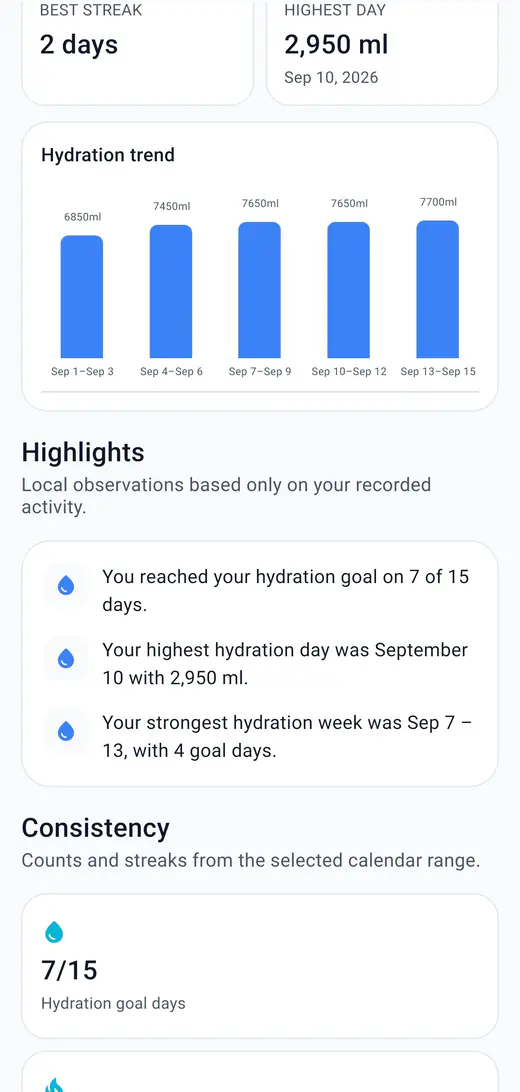
For a longer fast, an on-device hydration report is a faster way to check your best streak and highest logged day than scrolling back through daily entries by hand.
Common mistakes with water during a fast
- Under-drinking water because of a vague sense that all liquids count against a fast.
- Treating black coffee as calorie-free no matter how much cream or sugar gets added to it.
- Ignoring electrolytes on 18-hour-plus fasts, then blaming the fast itself for a sodium-loss headache.
- Waiting until feeling thirsty before drinking anything during a long fasting window.
- Trying to fit an entire day's water into a short eating window instead of spreading intake across the day.
Related HydroFast guides
Choose an intermittent fasting schedule
Compare 12:12 through OMAD and build an eating window around your day.
Fasting reminder app for Android
Set up start and completion alerts and fix missing or late notifications.
Build a water drinking habit
Anchor water logging to routines you already keep, on fasting days or not.
Water fasting app questions
Direct answers on tracking water and fasting side by side in HydroFast.
Frequently asked questions
Does drinking water break a fast?
No. Plain water has no calories, protein, fat, or carbohydrate, so it does not trigger the insulin response that ends a fasted state. Every common intermittent fasting protocol, including HydroFast's built-in plans, treats water as compatible with any fasting window.
Can I drink black coffee or plain tea while fasting?
Yes, in the practical sense almost every fasting guide uses. Black coffee and plain tea (no milk, cream, or sugar) have close to zero calories, so most people track them as fasting-safe. Adding milk, cream, or sugar changes that.
Do electrolytes break a fast?
Sugar-free electrolytes, meaning sodium, potassium, or magnesium without added carbohydrate, are generally treated as fasting-safe and can help with headaches or fatigue on longer fasts. Flavored or sweetened electrolyte drinks that contain calories are not the same thing.
How much water should I drink during a fasting window?
Fasting does not lower your baseline fluid need, so ordinary daily guidance still applies, and it helps to spread that intake across the fasting window rather than saving it all for your eating window. Individual needs vary with body size, activity, and climate.
Does flavored or sparkling water break a fast?
Plain sparkling or lightly flavored water with no sugar and no calories is generally treated as fasting-safe. Flavored waters that list sugar, juice, or calories on the label are not.
Can dehydration happen while intermittent fasting?
Yes, particularly on longer fasting windows if fluid and electrolyte intake both drop. Thirst, dark urine, headache, and lightheadedness are general dehydration signals worth acting on regardless of whether you are fasting.
Can HydroFast track water intake during a fast?
Yes. Water logs and the fasting timer run independently in HydroFast, so you can keep logging water while a fast is active without pausing or affecting the session.
Wellness disclaimer
HydroFast is a wellness and habit-tracking app. It does not provide medical advice, diagnosis, treatment, medically supervised fasting plans, or a calculated hydration target. Fluid needs differ with body size, activity, climate, health conditions, medication, and fasting window length, and both too little and too much fluid can matter. Fasting may not be suitable for everyone. Consult a qualified healthcare professional before changing your fasting routine, fluid intake, medication, or health plan.