
Quick answer
No single amount fits everyone. The U.S. National Academies set an Adequate Intake of about 125 oz (3.7 liters) of total water a day for men and 91 oz (2.7 liters) for women, counting water from food. Drinks usually supply about 80% of that: roughly 101 oz (3.0 L) for men and 74 oz (2.2 L) for women. Use those figures as a starting point, then adjust for activity, heat, pregnancy, and health.
Why every water rule gives a different number
The popular rules answer different questions. Some count only what you drink, while others count every source of water, including food. Some describe the typical intake of a large population; others are shortcuts designed to be easy to remember. Side by side, the gap is easy to see.
On a narrow screen, scroll the tables sideways. Keyboard users can focus a table and use the arrow keys.
| Rule | Daily amount | Where it comes from | What it misses |
|---|---|---|---|
| Eight 8-ounce glasses (8 × 8) | 64 oz (about 1.9 L) of drinks | Popular advice. A 2002 review found no scientific studies supporting it. | Ignores water from food and other drinks, body size, activity, and climate. |
| Half your body weight in ounces | 75 oz (2.2 L) at 150 lb; 100 oz (3.0 L) at 200 lb | Rule of thumb. Not part of U.S. or European reference values. | Uses weight as the only input, so results climb quickly for larger bodies. |
| U.S. National Academies | 91 oz (2.7 L) for women, 125 oz (3.7 L) for men, total water | Typical intakes of healthy adults in national survey data. | Counts food as well as drinks, and is not a strict requirement. |
| European Food Safety Authority | 2.0 L (68 oz) for women, 2.5 L (85 oz) for men, total water | Intakes in groups with healthy urine concentration. | Counts food as well as drinks, and assumes moderate heat and activity. |
| A gallon a day | 128 oz (about 3.8 L) of drinks | Social media challenges. | More than many people need, and safe only when spread across the day. |
Where eight glasses came from
In 2002, Dartmouth physiologist Heinz Valtin searched the research literature and consulted nutrition specialists for evidence behind "8 × 8." His review in the American Journal of Physiology found no scientific studies supporting it for healthy adults leading largely sedentary lives in a temperate climate. In the Dartmouth announcement of the review, Valtin suggested the idea may trace back to a Food and Nutrition Board recommendation of 1 milliliter of water for each calorie of food. The Board's next sentence, that most of this quantity is contained in prepared foods, seems to have been lost along the way.
Why one average cannot fit everyone
A 2022 study in Science measured water turnover, the total water the body uses and replaces each day, in 5,604 people aged 8 days to 96 years across 26 countries. Average turnover ranged from about 1 to 6 liters a day. According to the University of Wisconsin–Madison's summary, physical activity and athletic status had the largest effect. Athletes turned over about a liter more than non-athletes, men about half a liter more than women, and a 50% rise in humidity added about 0.3 liters.
Turnover includes water from food and from metabolism, so it is not a drinking target. The authors' point was simpler: a single number, such as eight 8-ounce glasses, is not supported by objective evidence.
How much water do adults need a day?
About 91 oz (2.7 liters) of total water for women and 125 oz (3.7 liters) for men, according to the U.S. National Academies, with roughly four-fifths coming from drinks. These are Adequate Intakes based on what healthy people typically consume, not minimums that everyone must reach.
| Group | Total water (food and drinks) | From drinks |
|---|---|---|
| Women | 91 oz (2.7 L) | about 74 oz (2.2 L), or 9 cups |
| Men | 125 oz (3.7 L) | about 101 oz (3.0 L), or 13 cups |
| Pregnancy | 101 oz (3.0 L) | about 78 oz (2.3 L), or 10 cups |
| Breastfeeding | 128 oz (3.8 L) | about 105 oz (3.1 L), or 13 cups |
The National Academies' water report states that the Adequate Intake "should not be interpreted as a specific requirement." For most healthy people, it says, thirst combined with drinking at meals keeps hydration on track from day to day.
European reference values are lower. The European Food Safety Authority considers 2.0 liters (68 oz) a day adequate for women and 2.5 liters (85 oz) for men, again counting water from food as well as drinks, under moderate temperatures and activity. The CDC does not publish a single daily amount; it notes that recommendations vary with age, sex, pregnancy, breastfeeding, and activity level.
What raises or lowers how much water you need
Reference values describe healthy adults in moderate conditions. Your own number moves with the factors below, and physical activity usually moves it most.
- Exercise and sweat. The National Academies cite sweat rates of about 0.7 liters (24 oz) an hour for female distance runners and 1.0 liter (34 oz) for male runners in temperate conditions, and more in the heat. The American College of Sports Medicine's position stand on fluid replacement aims to keep exercise water loss below 2% of body weight, and suggests weighing yourself before and after a session to estimate your own sweat rate.
- Heat and humidity. For moderate work in the heat that lasts less than two hours, NIOSH advises 1 cup (8 oz) of water every 15 to 20 minutes, and sports drinks with balanced electrolytes when sweating lasts several hours. For drink types and label-reading examples, compare electrolyte drinks with plain water.
- Body size, pregnancy, and breastfeeding. Body size and composition were among the factors linked to water turnover in the Science study, and pregnancy and breastfeeding raise the reference values shown in the table above.
- Illness. The CDC lists fever, diarrhea, and vomiting among the times your body needs more water.
- Food. Food normally supplies around a fifth of your water. Meals rich in fruit, vegetables, and soup supply more, and a day with little food supplies less. That matters on a long intermittent fast; see how much water to drink during a fasting window.
- Cold weather. General guidance does not change with the seasons, but cold weather weakens thirst. See how to stay hydrated in winter when you are not thirsty.
- Health conditions and medication. Some heart and kidney conditions call for a fluid limit. If a clinician has given you one, it takes priority over any general figure in this guide.
Should you drink half your body weight in ounces?
Treat it as a rough rule of thumb, not a guideline. Neither the U.S. National Academies nor EFSA sets water intake by body weight, and the rule's results spread out quickly as weight changes.
Body size does affect how much water you use, which is why the rule sounds sensible. The trouble is that weight is its only input. Here is what it produces:
- 120 lb (54 kg): 60 oz (1.8 L)
- 150 lb (68 kg): 75 oz (2.2 L)
- 180 lb (82 kg): 90 oz (2.7 L)
- 220 lb (100 kg): 110 oz (3.3 L)
- 250 lb (113 kg): 125 oz (3.7 L)
For a smaller, mostly sedentary person, the result can land below the drinks share of the U.S. reference values. For a larger person, it can climb well past them, even on a quiet day indoors. The metric formulas that circulate online, usually 30 to 35 ml per kilogram, are essentially the same rule: half an ounce per pound works out to about 33 ml per kilogram.
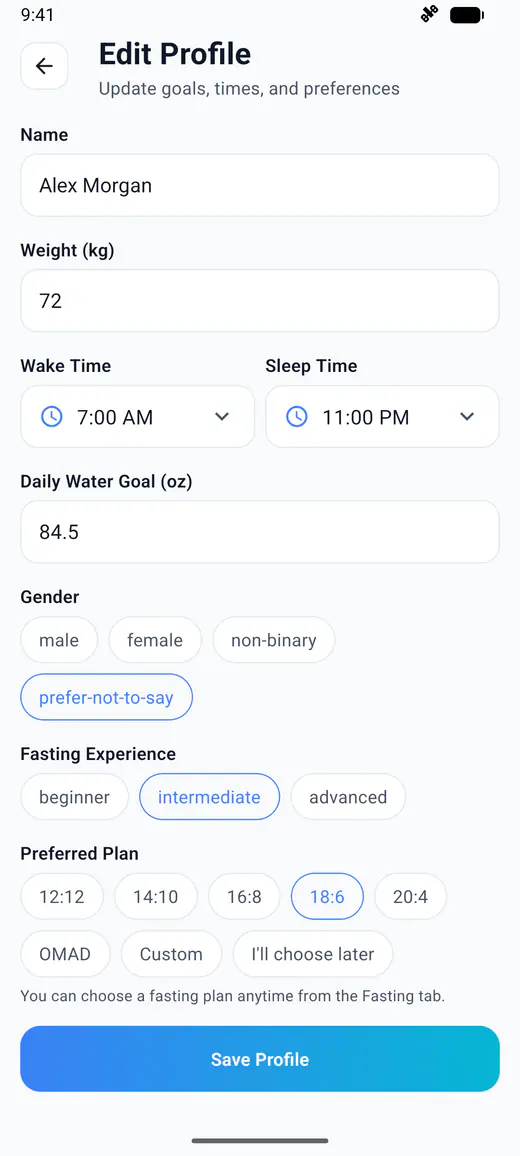
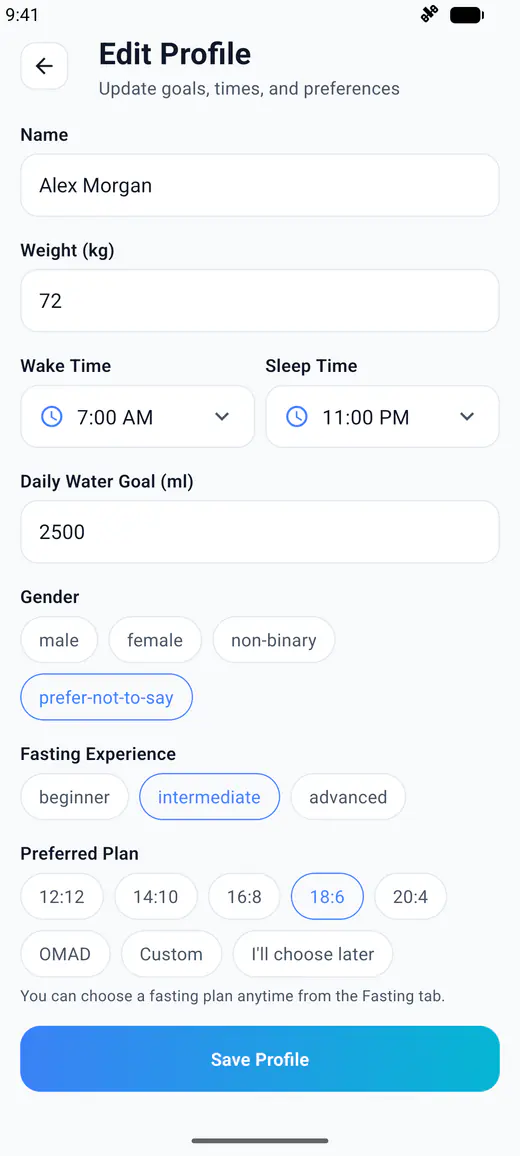
HydroFast keeps the two numbers apart. Profile Setup and Edit Profile ask for your weight in kilograms and your daily water goal in separate fields, and the app does not calculate one from the other. Your goal is whatever you type in.
Is drinking a gallon of water a day too much?
For most healthy adults, a gallon (128 oz, about 3.8 liters) spread across the day is not dangerous, but it is more than many people need. The real risk is drinking a large volume quickly.
The National Academies did not set an upper limit for water because healthy kidneys are very good at clearing the excess. That capacity has a rate, though: roughly 0.7 to 1.0 liters (about 24 to 34 oz) an hour. The same report notes that acute water toxicity has been reported after people rapidly drank large quantities, which can dilute the sodium in the blood, a condition called hyponatremia.
Spread over 16 waking hours, a gallon works out to 8 oz an hour, well inside that range. Downing a big bottle to hit a number before bed is a different matter. Even for people sweating hard at work in the heat, NIOSH says fluid intake generally should not exceed 6 cups (48 oz) an hour.
Challenges that set the same volume for everyone also skip the people who should not join them: anyone with a heart or kidney condition or a fluid limit from a clinician. If you have been drinking a lot very quickly and feel unwell, stop and get medical advice.
Do coffee, tea, and food count toward your daily water?
Yes. Water from coffee, tea, milk, and food all counts toward your total. Plain water is still the simplest choice because it has no caffeine, sugar, or calories.
The idea that coffee dehydrates you rests on caffeine's mild diuretic effect. The National Academies concluded that caffeinated drinks appear to contribute to daily water intake much like noncaffeinated ones. A 2014 study in PLOS ONE gave 50 men who already drank coffee daily either four 200 ml cups of coffee or the same amount of water each day, and found similar hydration markers. The study was small, included only habitual coffee drinkers, and was funded by the Institute for Scientific Information on Coffee, but its result matches the broader evidence. Food, meanwhile, covers around a fifth of daily water, and the CDC points to fruits and vegetables with high water content as useful sources.
One practical decision follows from all this. HydroFast records amounts, not drink types, so decide once whether your goal covers water only or every drink, and log the same way every day. Switching rules halfway through a month makes your history hard to compare.
How do you know if you are drinking enough?
Look for pale urine, regular bathroom trips, and rarely feeling very thirsty. Darker urine, urinating less often, a dry mouth, headaches, and muscle cramps are among the signs of mild dehydration.
MedlinePlus lists those signs, along with thirst and dry skin, as mild to moderate dehydration. Thirst is a reasonable guide for most healthy people, which is part of why the National Academies do not treat their figure as a requirement. It is weaker in cold weather, though, and older adults face a higher risk of dehydration. Urine color and frequency are harder to misread, so they make the better daily check while you test a new goal.
Confusion, dizziness, a rapid heartbeat, very dark urine, or no urine at all are signs of severe dehydration that need urgent medical care.
How to set a daily water goal you can test
Think of a water goal as a first guess about your own needs. These steps turn the reference values into a number, then check it against what your body and your log show.
- Start from a reference or from your real intake. Without any data, the drinks-only U.S. figures, about 74 oz (2.2 L) for women and 101 oz (3.0 L) for men, are a reasonable starting point. If you have logged a typical week, start from your actual average instead. A goal far above what you drink today is hard to keep up.
- Decide what counts. Choose water only or every drink, and keep that rule.
- Spread it across your waking hours. A 90 oz goal over 16 waking hours (7 AM to 11 PM) comes to about 5.6 oz an hour, or one 16.9 oz bottle roughly every three hours.A 2,700 ml goal over 16 waking hours (7 AM to 11 PM) comes to about 170 ml an hour, or one 500 ml bottle roughly every three hours. Steady drinking is easier to sustain than catching up at night.
- Handle sweaty days separately. Set the everyday goal for an ordinary day, then add water for workouts and heat, using NIOSH's cup every 15 to 20 minutes for hot work or your own before-and-after weigh-in for exercise. A goal built for your hardest day turns every easy day into a miss.
- Test it for two weeks. Watch goal completion, urine color, and thirst. If you reach the goal comfortably and your urine stays pale, it fits. If you are often thirsty or your urine runs dark even on goal days, add a little. If you rarely reach it but feel fine, the goal may be higher than you need, or the problem may be a long stretch of the day without a drink. For help with that second problem, see how to build a water drinking habit that survives a busy day.
- Adjust in small steps. Change the goal by about 8 oz (250 ml) at a time, and give each change a week before judging it.
- Revisit when life changes. A new training plan, a hot summer, pregnancy, a new medication, or advice from a clinician are all reasons to reset the goal.
Setting and checking your goal in HydroFast
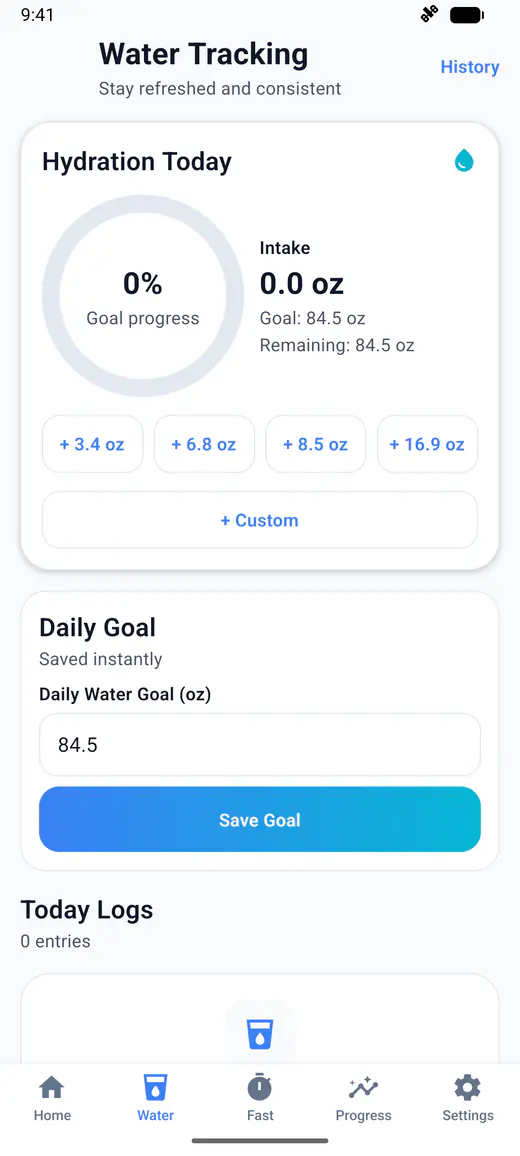
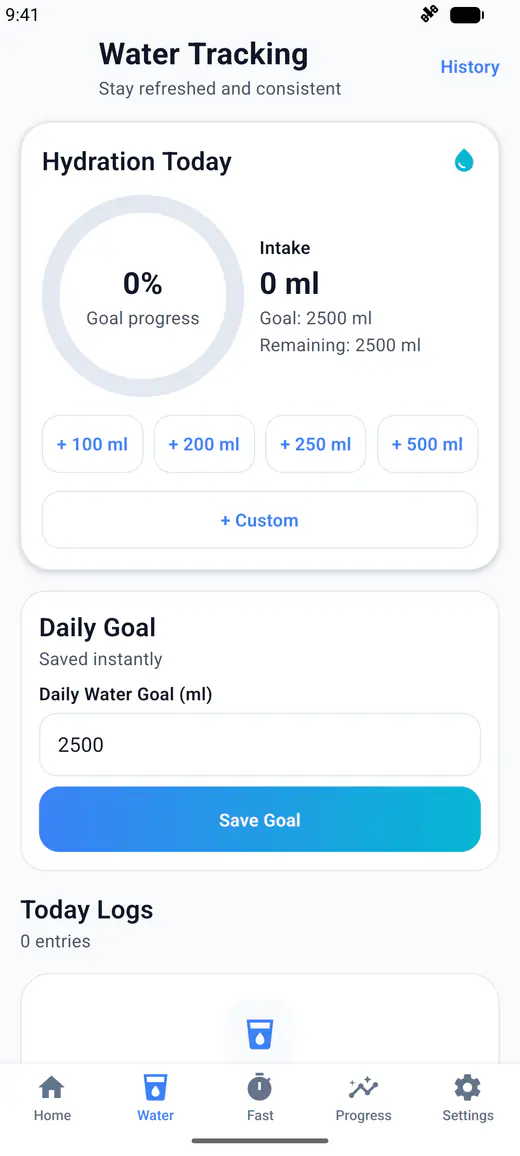
HydroFast will not pick a number for you. The free Android app has no goal calculator, no weather adjustment, and no suggested goal. Every new profile starts at 2,500 ml (about 84.5 oz), which you can replace during Profile Setup or later. The Daily Goal card on the Water tab, shown at the top of this guide, and the Daily Water Goal field in Edit Profile both accept anything from 500 to 8,000 ml (about 16.9 to 270.5 oz), and ounce goals can include a decimal. Switch Units to oz in Settings and the goal keeps its value, so you can track your daily water intake in ounces without re-entering it.
To spread the goal across the day, set hydration reminders between your wake and sleep times. They can repeat every 30 to 180 minutes, fire at specific times, or adapt to how much you have already logged when smart reminders are on.
After two weeks, open the Progress screen and switch to Week or Month. Goal Completion shows the share of days you reached your target, Avg Intake shows what you actually drank per day, and Best Day marks your highest-intake day.
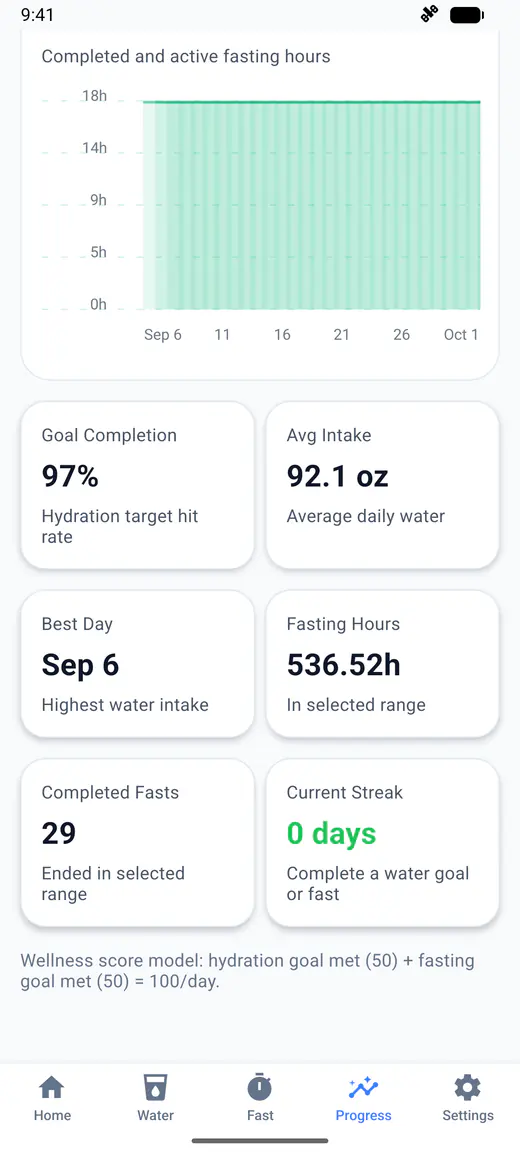
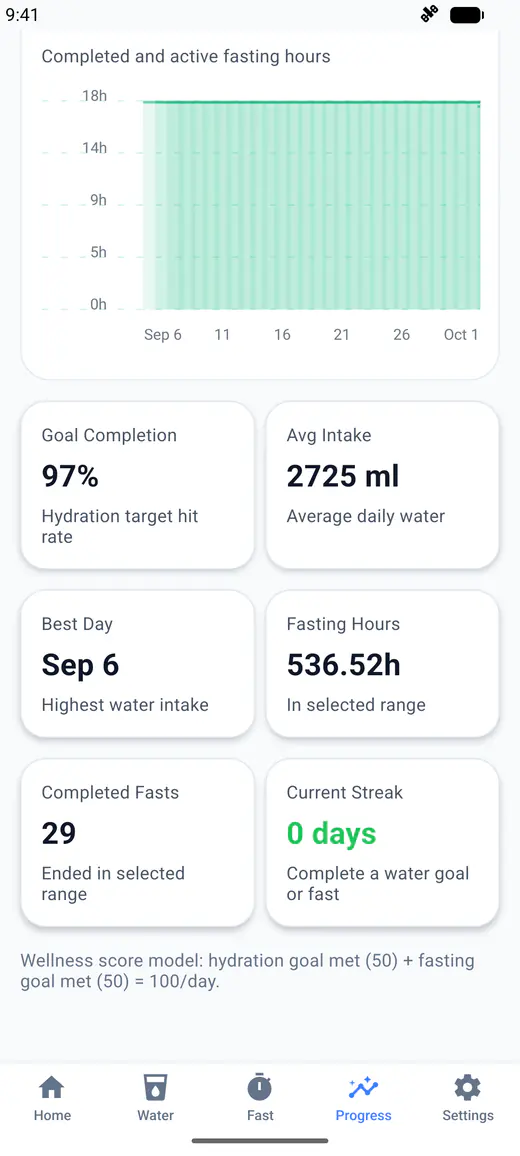
Read the two figures together. A high completion rate with an average well above your goal means the goal is easy for you: keep it if you feel well, or raise it to match what you already drink. A low completion rate with an average close to the goal usually points to a handful of short days rather than a wrong goal. For a longer view, HydroFast reports calculate average daily intake, goal days, and goal-completion rate for any date range on your phone.
Change your goal deliberately
One detail is worth knowing before you edit the number. HydroFast keeps only your current goal, not a history of past goals, so every logged day is measured against today's target. Raise your goal from 80 to 90 oz, and a day when you drank 85 oz stops counting as a goal day.Raise your goal from 2,400 to 2,700 ml, and a day when you drank 2,550 ml stops counting as a goal day. Your hydration streak can shrink, and goal-completion figures in Progress and reports drop for days you have already logged. Achievements you have already unlocked stay unlocked. That is one more reason to change the goal in small, deliberate steps instead of nudging it every few days.
The short version
The right amount of water is the amount that keeps you comfortably hydrated on your ordinary days, and no rule of thumb can know that in advance. Start from a reference value or from what you already drink, spread it across your waking hours, add water for heat and exercise instead of inflating the everyday goal, and judge the number by two weeks of logs, urine color, and thirst. If you would rather not keep that log on paper, HydroFast's hydration tracker records each drink against the goal you choose.
Related HydroFast guides
Build a water drinking habit
Anchor drinks to routines you already keep so busy days still include water.
Drinking water while fasting
What breaks a fast, which drinks are fasting-safe, and how much water still helps.
Stay hydrated in winter
Why cold weather dulls thirst and how to keep drinking when it does.
Review hydration progress
Today, Week, and Month views with goal completion, averages, history, and streaks.
Daily water intake FAQ
How many ounces of water should I drink a day?
U.S. reference values from the National Academies put total water at about 91 oz (2.7 liters) a day for women and 125 oz (3.7 liters) for men, including the roughly 20% that comes from food. From drinks alone, that is about 74 oz for women and 101 oz for men. Your own needs can be lower or higher depending on body size, activity, heat, pregnancy, and health.
Is 8 glasses of water a day a myth?
As a universal rule, yes. A 2002 review in the American Journal of Physiology found no scientific studies supporting eight 8-ounce glasses (64 oz) a day for healthy adults. The amount is not harmful and is close to what some people drink, but it ignores water from food and other drinks and does not adjust for body size, activity, or climate.
Do women and men need different amounts of water?
On average, yes. The U.S. National Academies set total water at about 91 oz (2.7 liters) a day for women and 125 oz (3.7 liters) for men, and a 2022 study in Science found that men turned over about half a liter more water a day than women. Pregnancy raises the U.S. reference to about 101 oz (3.0 liters) and breastfeeding to about 128 oz (3.8 liters). Activity and body size also make a large difference.
How much more water should I drink when I exercise?
It depends on how much you sweat, which varies widely. The National Academies cite sweat rates of about 24 oz (0.7 liters) an hour for female distance runners and 34 oz (1.0 liter) for male runners in temperate conditions, and more in the heat. The American College of Sports Medicine suggests weighing yourself before and after exercise and keeping water loss below 2% of body weight. For moderate work in the heat, NIOSH advises 1 cup (8 oz) every 15 to 20 minutes.
Should I drink my water all at once or spread it out?
Spread it out. Healthy kidneys clear roughly 24 to 34 oz (0.7 to 1.0 liters) of water an hour, and drinking a large volume much faster than that can dilute the sodium in your blood. A 90 oz goal over 16 waking hours works out to about 5.6 oz an hour, or one 16.9 oz bottle roughly every three hours.
Do I need electrolytes in my water every day?
Usually not on a mostly sedentary day. NIOSH recommends sports drinks with balanced electrolytes when sweating lasts several hours, and the American College of Sports Medicine notes that drinks with electrolytes and carbohydrates can help during exercise in certain circumstances. Neither recommends them as a daily habit for ordinary days.
Does HydroFast calculate my daily water goal?
No. HydroFast does not suggest or calculate a goal, and it does not use your weight or the weather to set one. You enter the daily goal yourself, anywhere from 500 to 8,000 ml (about 16.9 to 270.5 oz), starting from a 2,500 ml (about 84.5 oz) default, and you can change it at any time on the Water tab or in Edit Profile.
Wellness disclaimer
HydroFast is a wellness and habit-tracking app. It does not provide medical advice, diagnosis, treatment, or a calculated hydration target. The figures in this guide are general reference values for healthy adults, not a personal prescription. Fluid needs differ with body size, activity, climate, pregnancy, health conditions, and medication, and both too little and too much fluid can matter. Talk to a qualified healthcare professional before changing your fluid intake if you have a medical condition or have been given a fluid limit.